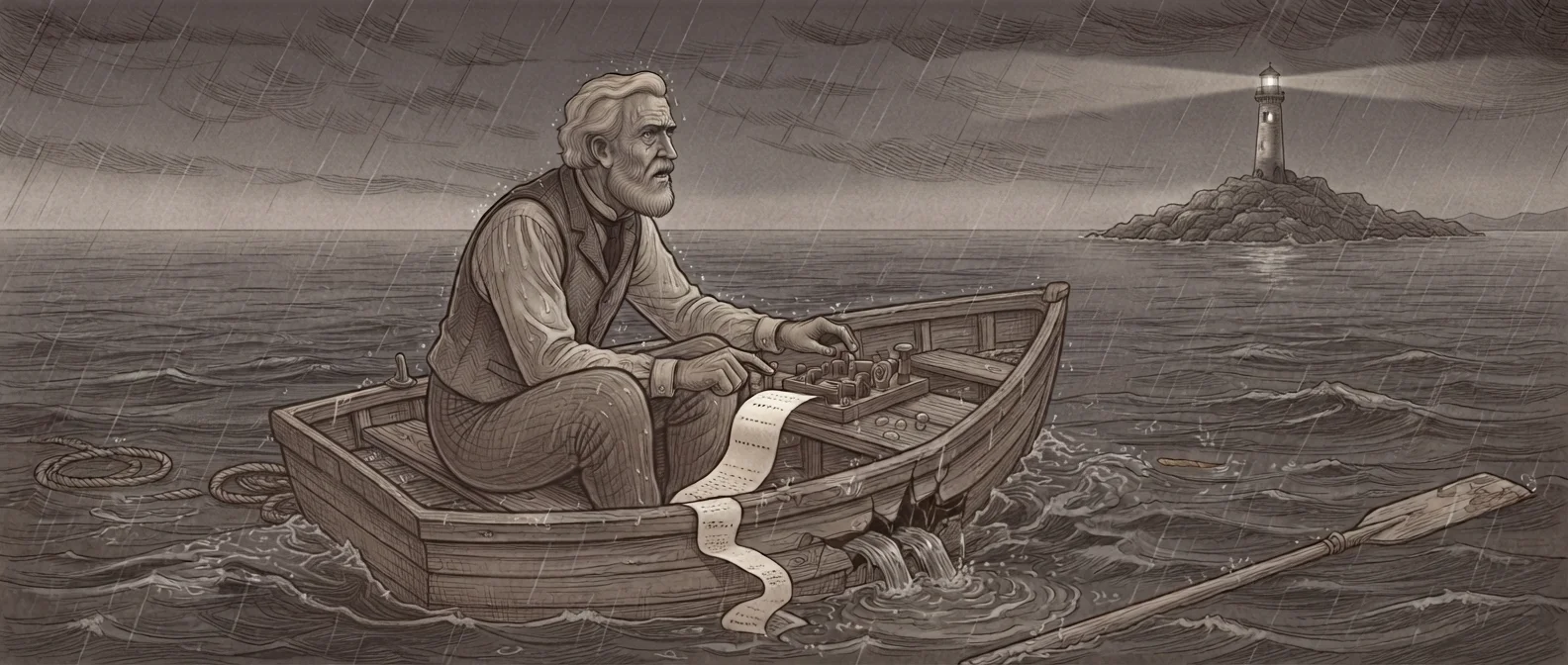
How to Write “Help” in Morse Code
“Help” in Morse code is written as:
···· · ·-·· ·—·
This four-letter emergency word is quick to transmit and universally understood. Here’s how each letter breaks down:
To send “Help”:
- H: Four quick dits (dit-dit-dit-dit)
- E: One dit (dit)
- L: Dit-dah-dit-dit
- P: Dit-dah-dah-dit
The word takes about 1.5 seconds at standard speed. Unlike SOS, “Help” is spelled out letter by letter with normal pauses between letters.
What to Know Before You Use It
While SOS is the official international distress signal, “Help” has its own practical uses in emergency communication:
When to use “Help” vs “SOS”:
| Situation | Use |
|---|---|
| Life-threatening emergency, need rescue | SOS |
| Need assistance but not life-threatening | HELP |
| Maritime/aviation distress | SOS |
| General emergency, any context | Either |
| Attracting nearby attention | HELP |
Practical uses for “Help” in Morse code:
- Signaling a friend that you need assistance
- Teaching emergency communication to children (easier to remember than SOS)
- Escape rooms and puzzle games
- Communicating through walls or barriers
Key difference: SOS is a prosign (sent without letter breaks), while “Help” is sent letter by letter. SOS is internationally standardized; “Help” is an English word that might not be understood by non-English speakers in dire emergencies.
Breakdown of Each Letter
| Letter | Morse Code | Sound | Pattern |
|---|---|---|---|
| H | ···· | dit-dit-dit-dit | 4 shorts |
| E | · | dit | 1 short |
| L | ·-·· | dit-dah-dit-dit | short-long-short-short |
| P | ·—· | dit-dah-dah-dit | short-long-long-short |
Memory aids:
- H: “Ha-ha-ha-ha” (four quick laughs)
- E: The shortest and most common letter — just one dit
- L: “eLevator” — the rhythm matches the word
- P: Like a mirror of L — starts and ends with dit, two dahs in the middle
Common Mistakes to Avoid
-
Confusing H and S: H is ···· (four dits), S is ··· (three dits). Count carefully — one extra dit makes a big difference.
-
Mixing up L and P: They’re similar but different:
- L: ·-·· (dit-DAH-dit-dit) — dash is second
- P: ·—· (dit-DAH-DAH-dit) — two dashes in the middle
-
Sending it as one continuous signal: Unlike SOS, “Help” should have clear pauses between letters. H [pause] E [pause] L [pause] P.
-
Forgetting that “Help” is English: In a true international emergency, SOS is more universally recognized. “Help” works best when you know the receiver understands English.
-
Rushing through fear: In an emergency, adrenaline makes people rush. Slow, clear signals are more effective than fast, garbled ones.
Frequently Asked Questions
Should I use “Help” or SOS in an emergency?
Use SOS if:
- You’re in a life-threatening situation
- You need professional rescue (coast guard, search and rescue)
- You’re signaling to strangers or internationally
- You’re using maritime or aviation protocols
Use “Help” if:
- You need assistance but your life isn’t in immediate danger
- You’re communicating with someone who speaks English
- You’re teaching children emergency signals
- The situation is urgent but not critical
When in doubt, use SOS — it’s universally understood and taken seriously.
How do I tap “Help” on a wall or surface?
When trapped or trying to communicate through a barrier:
- H: Tap quickly four times (tap-tap-tap-tap)
- Pause briefly
- E: Tap once (tap)
- Pause briefly
- L: tap-THUMP-tap-tap (short-long-short-short)
- Pause briefly
- P: tap-THUMP-THUMP-tap (short-long-long-short)
For the long signals (dashes), press harder or longer against the surface. Repeat the sequence and wait for a response.
Can “Help” be sent with light signals?
Yes. Use any light source:
- H: Four quick flashes
- Pause
- E: One quick flash
- Pause
- L: Quick-long-quick-quick
- Pause
- P: Quick-long-long-quick
Long flashes should be about 3x the duration of quick flashes. Repeat every 10-15 seconds.
How is “Help” used in ham radio?
In ham radio, operators rarely spell out “Help” in an emergency. Instead, they use:
- MAYDAY: Voice distress call (most urgent)
- PAN-PAN: Urgent but not immediately life-threatening
- SOS: Morse code distress signal
However, if spelling words is necessary, “Help” is perfectly valid and understood by English-speaking operators.
What other emergency words should I know in Morse code?
Essential emergency vocabulary:
| Word | Morse Code |
|---|---|
| SOS | ··· --- ··· (no spaces) |
| Help | ···· · ·-·· ·—· |
| Mayday | — ·- -·— -·· ·- -·— |
| Danger | -·· ·- -· —· · ·-· |
| Fire | ··-· ·· ·-· · |
| Water | ·— ·- - · ·-· |